 Ryan Echternacht
Freemium pricing helps SaaS companies attract more users, lower sign-up friction, and support product-led growth. However, many teams struggle to turn free users into paying customers.
A low freemium-to-paid conversion rate means the product may not give users a clear reason to upgrade. Free users may fail to see value, complete onboarding, reach usage limits, or understand what they gain from a paid plan.
Tracking freemium-to-paid conversion rates is important to identify and close gaps in your pricing strategy. Conversion data will help you decide which features to gate, where to add usage limits, and how to structure tiered pricing plans.
This guide explains the definition of freemium-to-paid conversion rates, the factors that affect conversion, and tips for optimizing rates.
TL;DR
- The freemium-to-paid conversion rate tracks how many users upgrade from the free plan to the paid tier.
- Product-market fit, time to value, onboarding, plan limits, unclear pricing, and acquisition channels can impact conversion rates.
- Calculate the conversion rate by dividing the number of converted customers by the total number of freemium users, then multiplying by 100.
- SaaS teams can improve freemium conversion by offering faster value realization, personalized onboarding and product experiences, clear upgrade paths, reverse trials, simple pricing pages, strategic upgrade prompts, social proof, and loyalty programs.
- Schematic helps SaaS companies drive upgrades through metered paywalls and usage limits.
What Is Freemium-to-Paid Conversion in SaaS?
Freemium-to-paid conversion in SaaS is the process of turning freemium users into paying customers. These users begin with ongoing access to a free version of the product. Later on, they upgrade when they need full feature access, advanced capabilities, higher limits, or better customer support.
The freemium-to-paid conversion rate measures the percentage of free users who move to a paid tier during a set period.
It helps SaaS companies see how well the free plan encourages users toward a purchase and whether the paid subscription offering gives customers a clear reason to upgrade.
According to Kyle Poyar and Lenny Rachitsky's analysis of 1,000 products, 3%-5% is considered a good conversion rate, and 6%-8% is great for a freemium self-serve product. If the sales team is involved in converting freemium users, 5%-7% is a good rate, and 10%-15% is deemed great.
Freemium Model vs. Free Trial: How Do They Differ?
A freemium model gives users ongoing access to a limited version of a product at no cost. A free trial, on the other hand, provides full access to the product's premium features and offerings for a short time.
Freemium customers can keep using the free plan for as long as they want. They may have little reason to upgrade right away. This makes freemium a long-term user acquisition model and often leads to lower conversion rates.
Canva, Slack, and PostHog are examples of successful freemium products. They use freemium pricing to attract users before converting most of them into paid users.
Unlike freemium, which keeps access open, a free trial model creates a sense of urgency because product access ends once users complete the trial period. For this reason, free trial conversion rates are higher than freemium.
Zoho and Intercom are successful companies that offer free trials to engage users and encourage them to sign up for a paid plan.
However, despite free trials converting customers at better rates, they can attract fewer users overall because of the higher barrier to entry. Most trial structures require new users to share their credit card details in advance.
Factors That Influence Freemium-to-Paid Conversion Rates
Many factors shape how many free-tier users convert to paying customers. Let's break down each one below.
Product-Market Fit
Strong product-market fit means the product solves a clear pain point for its target audience. Users are more likely to pay when the product helps them complete an important task or reach a successful result.
However, not every free user will fit the ideal customer profile or have a real need for a paid plan.
SaaS companies should carefully review which customer groups activate, return, and upgrade. This helps go-to-market and sales teams focus on the people most likely to gain enough value from the product to pay for it.
Time to Value
Time to value is how long it takes a new user to get positive results from the product.
Complex products, especially SaaS and AI-powered platforms, are usually at a disadvantage because the path to value realization is often longer.
A confusing setup process can also delay the user's desired outcome and lower the chances of conversion. Users may leave before they understand how upgrading can help them.
SaaS companies should aim to shorten the time to value to improve conversion optimization. The sooner users complete a key task or solve a real problem, the more likely they are to see why a paid plan is worth the cost.
Onboarding and Product Experience
Onboarding should guide new users toward the actions that show the product’s core value.
An effective free user experience helps people understand what to do, where to start, and which features support their goals.
However, when setup takes too long, or the product is difficult to use, users drop off before they see value.
SaaS companies should remove complicated steps, explain key benefits, and use prompts based on user behavior. Doing so gives users more reasons to return, use the product, and consider a paid plan.
Free Tier Limitations
Free tier limits shape when and why users consider upgrading. SaaS teams may limit usage, storage, team seats, projects, integrations, or access to advanced features. These restrictions should still allow users to test the product and see its value before asking them to pay.
Limitations that appear too soon can push users away before they understand the product. Meanwhile, a generous free tier can remove the need to upgrade.
There should be a balance to drive natural upgrades and expansions.
Pricing Transparency
Website visitors are less likely to upgrade when they cannot understand the price, billing terms, or differences between plans. A clear pricing page helps them compare options and choose the paid tier that fits their needs.
Your SaaS company should effectively communicate pricing and highlight advanced features. Avoid unnecessary details or complex pricing tables. The goal is to explain each option without overwhelming users.
Customer Acquisition Channel
The source of free sign-ups can strongly affect paid conversion rates.
New users who come from referrals, targeted search terms, partner sites, or direct recommendations may have a clear problem they want to solve. In these cases, users sign up with purchasing intent and are more willing to pay after seeing the product's value.
Running paid ads or low-intent campaigns may bring more free accounts. However, most of these users might never convert to paying customers.
SaaS companies should compare activation, upgrade, retention, and account value by acquisition channel. This can reveal which sources bring users who have a real need for a paid plan.
How to Calculate Freemium Conversion Rates
To compute the freemium-to-paid conversion rate, divide the number of free users who upgraded within a time window by the total number of free sign-ups. Then, multiply the result by 100.
Here's the formula for calculation:
Freemium conversion rate = (Free users who became paid customers ÷ Total free users) × 100
Let's say 5,000 users joined your free plan during one month. If 200 of those users upgraded to a paid tier, your freemium conversion rate would be 4%.
Use a set time frame, such as 30, 60, or 90 days, when tracking conversions. This makes it easier to compare results over time.
Make sure to remove test accounts, beta users, employees, and spam accounts in the calculation so they do not affect the final rate.
Tips for Increasing Free-to-Paid Conversion Rates in SaaS
Implementing the optimization strategies below helps free users see more value, reach upgrade points, and understand why a paid plan fits their needs.
1. Rethink the Freemium Offering
Review which features, limits, and services are included in your free plan. Users need enough access to understand the product, but they should also have clear reasons to upgrade as their needs grow.
Reserve higher usage limits, team controls, automation, integrations, reporting, and support for paid tiers.
The right offer depends on your product and target audience. A basic tool may limit projects or exports, while enterprise software might charge for advanced security, permissions, and admin controls.
Make sure there's a balance between offering value and encouraging freemium users to pay for a paid subscription.
You should also review your unit economics. Storage, support, third-party services, and AI usage can make free accounts costly to serve, which can erode your profit margins.
2. Shorten the Path to Value Realization
Let freemium users interact with the product before asking them to create an account. An ungated product feature, calculator, editor, or sample workspace allows them to understand the product faster and build a habit around it.
The goal is to help users reach the "aha" moment as quickly as possible to prevent churn and increase the chances of conversion.
You can start with one simple action that shows a useful result. Remove extra forms, setup steps, and questions that are not needed at this stage.
Ask users to register only when they want to save work, invite teammates, export results, or continue using the product.
Then, track where users progress and where they stop. This helps your team find steps that delay time to value.
A shorter path to value realization gives users a clear reason to return, sign up, and move to a paid plan.
3. Deliver Personalized Experiences
Users sign up for a freemium product for different reasons. Analyze user behavior and company role to show content that fits each user’s needs. A marketer may need campaign templates, while a developer might look for API setup steps.
Personalization can shape onboarding tasks, feature tips, email messages, and upgrade prompts. Show features based on what users are trying to do rather than promoting every paid feature at once.
You can also recommend a paid plan after users complete key actions or reach a usage point.
Relevant guidance helps users find value faster. It also makes upgrade messages feel connected to a real need instead of a generic sales push.
4. Simplify Onboarding
A poor onboarding flow can cause users to drop off before they see what the product can do.
Remove extra fields, setup steps, and product tours that are not needed for the first useful result. Consider breaking complex tasks into small steps and showing users what to do next.
Use checklists, templates, progress bars, short tips, and sample projects to support new users. Let people skip steps that do not apply to their specific needs, roles, or business goals.
Make sure to review onboarding data often. Find the steps with the highest exit rates, test simpler options, and guide more users toward the actions linked to paid conversion metrics.
5. Launch Reverse Trials
A reverse trial gives new users temporary access to the full platform when they sign up. Once the trial period ends, users who do not pay revert to the product's free version instead of losing access completely.
This approach differs from standard freemium, where users begin with limited features and may never see what the paid plans can do. Upgrade prompts alone may not show why premium features are worth paying for.
Reverse trials let people test advanced capabilities in real workflows. Trial users can see how higher limits, automation, reports, or team features support their goals. Once they are downgraded to the free plan, they already know what's missing and are more likely to pay for the premium tier.
6. Create Strategic Upgrade Paths
Show upgrade prompts after users reach clear activation points. These may include finishing a first project, inviting teammates, connecting an app, or using a core feature several times. At that point, users already understand the product and are more open to paying.
You can also enforce metered paywalls when a free user reaches a usage cap, needs more storage, wants a premium feature, or exceeds the number of AI credits on their plan.
Keep each upgrade message tied to the action the user just took. Explain the additional value instead of showing a general sales message.
Use product data to find the moments that often come before payment. Well-timed prompts help you capitalize on conversion momentum when the need for a paid plan is clear.
7. Improve Your SaaS Pricing Page
Your pricing page should make it easy for free users to compare plans and choose the right option.
Use simple plan names, clear prices, and short descriptions of who each plan is for. Show the main differences in features, usage limits, support, and team access.
Focus on benefits that connect to the needs free users already have. For example, explain how a paid plan saves time, increases direct revenue, or gives teams stronger security controls.
Don't forget to include monthly and annual billing terms, overage charges, and cancellation details. Add a direct call to action for each plan to guide website visitors on what to do next.
8. Share Social Proof
Social proof helps users feel more confident about paying.
It’s important to include relevant case studies, customer reviews, logos, and short success stories on your pricing page, emails, and upgrade screens.
Share examples that show a clear result, such as time saved, faster work, or reduced risks.
Match proof to the user’s role or use case when possible. A small business owner may respond to a story from another small team, while a larger company might care more about security and compliance.
Strong word-of-mouth or network effects can lower doubt because users see that others already trust the paid product.
9. Segment Users to Improve Data-Driven Decision-Making
Group freemium users by company size, role, activity level, and feature usage patterns. These segments show which users are most likely to pay and what often leads to an upgrade.
For example, one group may convert after inviting teammates, while another may pay after reaching a usage limit. Use that data to improve your freemium offering, onboarding strategy, upgrade prompts, and pricing page.
In addition to conversion rates, you should track retention, customer acquisition cost, customer lifetime value, and annual recurring revenue generated by each segment.
This helps your sales team focus on users who bring strong long-term value instead of chasing low-quality leads.
10. Develop a Loyalty Program
Not every user needs to become a paying customer to create value for your SaaS company.
Some people can support growth by referring new users, writing positive reviews, sharing content, or recommending the product to their teams.
Establish a loyalty program to reward these actions with discounted subscription rates, extra account credits, or early feature access. These give free users a strong reason to promote the product even when they are not ready to upgrade.
The program should focus on actions that bring in qualified users. For example, you can reward referrals after a new user moves to a paid tier, not just after they sign up for a free account. Doing so creates a growth loop that supports user acquisition alongside your upgrade funnel.
Schematic Helps Improve Freemium-to-Paid Conversion Rates
Schematic is the monetization operating system that helps SaaS companies unlock pricing as a growth lever. It provides a single source of truth for your product catalog.
Go-to-market teams can ship freemium pricing, launch trials, enforce limits, and manage software entitlements without hardcoding pricing logic into the application.
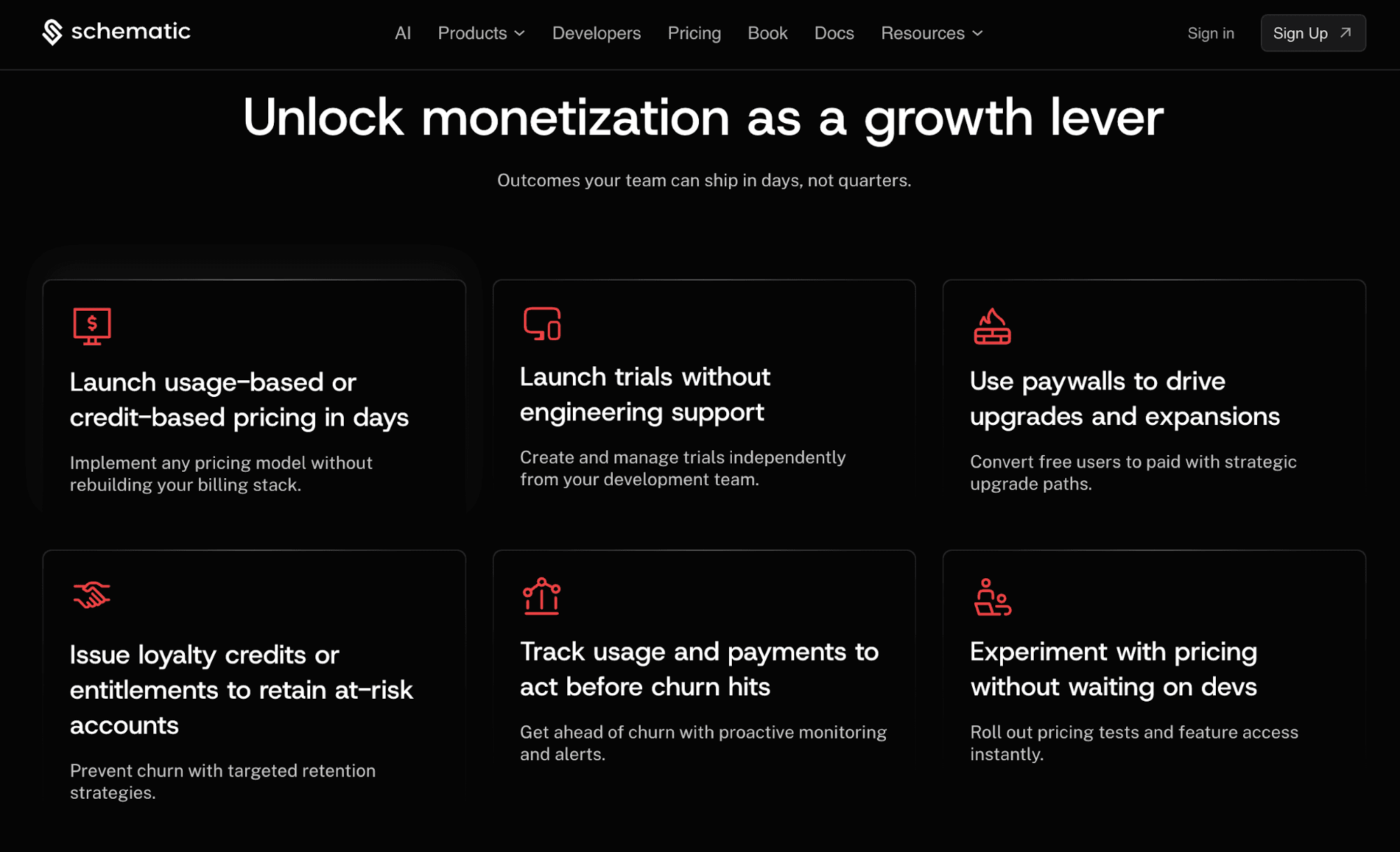
Schematic increases freemium-to-paid conversion rates by using metered paywalls. When free users reach a limit or need more access, the platform can show a clear path that drives upgrades and account expansion.
Built on Stripe, Schematic empowers commercial teams to continuously iterate on SaaS monetization without submitting engineering tickets. Developers only need to write two calls instead of two hundred lines.
Stripe continues to generate invoices, process payments, and manage taxes. Schematic adds feature access control, limit enforcement, usage metering, billing components, and revenue insights on top of Stripe.
FAQs About Freemium-to-Paid Conversion SaaS
What is the average conversion rate in a freemium business model?
The average freemium conversion rate often falls between 2% and 5%. Results vary by product type, audience, unique value proposition, and pricing.
What is considered a good freemium conversion rate?
A good freemium conversion rate is one that supports steady revenue while attracting enough free users. Above 5% is an acceptable conversion rate for many freemium products.
How to convert free users to paying customers?
Help free users reach value quickly, then offer clear reasons to upgrade. Enforce plan limits, improve onboarding, personalize customer experiences, and show clear pricing to drive conversions.
Is freemium better than a free trial?
A freemium business model is better for products with a higher potential for viral growth and massive adoption. A free trial can work when users can see the full product’s value within a short period. The right choice depends on your exact product, target audience, and sales cycle length.